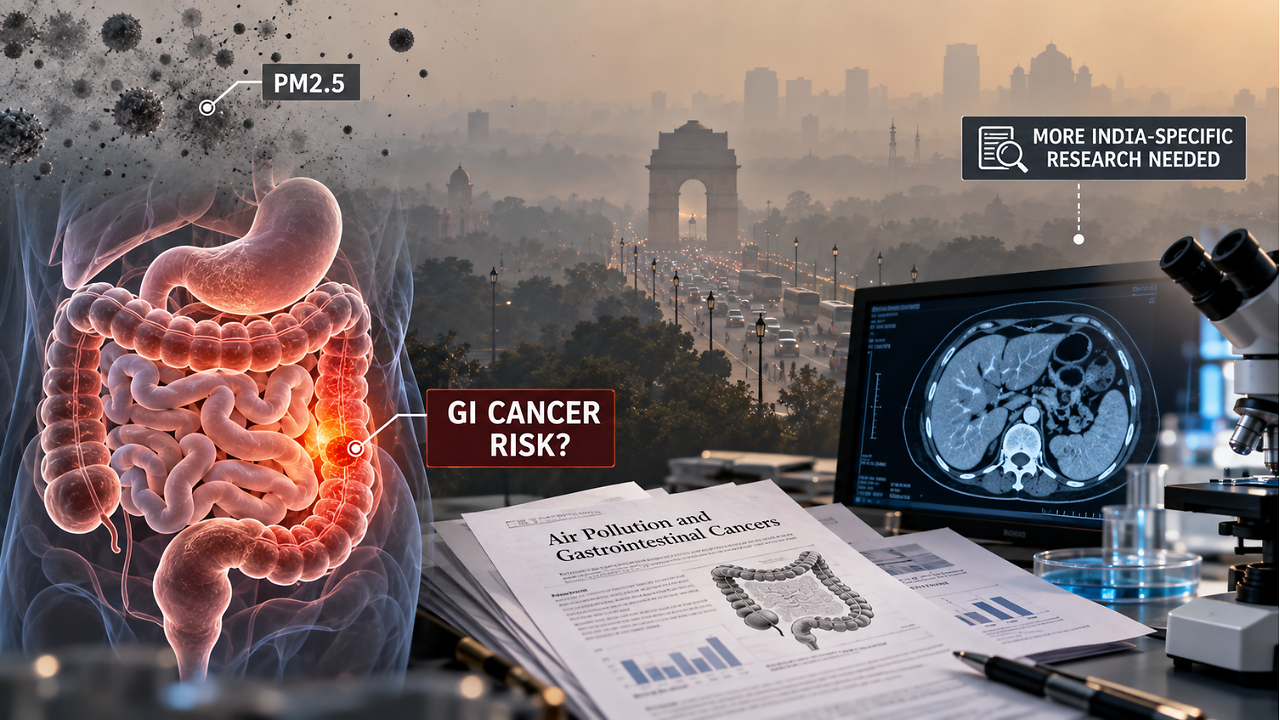
As Delhi gears up for another season of air pollution, cancer experts are raising concerns about long-term exposure to pollutants and whether it could contribute to gastrointestinal (GI) cancers. Doctors at Sir Ganga Ram Hospital have reported seeing GI cancer patients as young as 15, raising questions about the environmental factors that could affect cancer risk among young population. The discussion took place at a joint international conference organised by Sir Ganga Ram Hospital, New Delhi, and The Christie NHS Foundation Trust, UK, on October 10 and 11, 2026. The conference focused on advancements in colorectal and other gastrointestinal cancers, where experts highlighted the need for stronger prevention efforts, earlier diagnosis and India-based research. However, although many studies have linked long-term air pollution with cancer risk, the evidence does not establish that Delhi’s pollution is causing GI cancers in younger patients directly or that ground-level ozone is driving a surge. GI Cancer Patients As Young As 15 Also read: Delhi Smog: Can You Really Tackle Pollution Season With An N95 Mask And Air Purifier?Dr. Shyam Aggarwal, Organising Chairperson of the conference and Chairperson of the Department of Medical Oncology at Sir Ganga Ram Hospital, said the age of some patients presenting with GI cancers had prompted concern. “Cancer prevention can no longer be discussed only in terms of tobacco, diet and lifestyle. In our OPD we are now seeing new GI cancer patients as young as 15 years old which was uncommon 5 years ago. We must also pay attention to the environment in which people live,” he said. Aggarwal also called for closer attention to ground-level ozone, a pollutant that receives less public attention than particulate should also be studied. “The latest international studies have strengthened the case for investigating the relationship between air pollution and cancer. Ozone deserves particular attention because public awareness largely focuses on PM2.5 and PM10, while ground-level ozone is a less familiar threat. We need more India-specific evidence to understand the contribution of these pollutants, particularly in cities with persistently poor air quality.” The question of environmental exposure comes amid wider concerns about changing cancer patterns and diagnoses among younger adults. An observation by Aggarwal examining birth-cohort trends in gastrointestinal cancers in England and India highlights differences between the two countries. In England, bowel cancer incidence among people under 50 rose from 3.9 per 100,000 in 2001 to 8.4 per 100,000 in 2023, more than doubling during the period. In comparison, India’s early-onset colorectal cancer rate remains relatively low, at 3.5 per 100,000 among people aged 25 to 49. However, Indian urban cancer registries show an increase in colorectal cancer, while hospital studies have reported younger patients presenting with advanced disease. Link Between Air Pollution And GI Cancer Also read: Left Delhi To Escape Air Pollution? Why Health Effects May Linger For A Long TimeA 2026 review published in Epidemiologic Reviews examined 70 studies investigating associations between air pollution and gastrointestinal diseases. Researchers reported that long-term exposure to fine particulate matter, or PM2.5, was associated with higher mortality from GI cancers, especially colorectal cancer. PM2.5 consists of fine airborne particles small enough to penetrate deep into the lungs. Its health effects are not limited to the respiratory system, with research also examining its links to cardiovascular disease and other long-term health outcomes. The review suggests that prolonged exposure to air pollution may be relevant to cancer prevention. But, an association between exposure and cancer mortality does not, on its own, prove that the pollutant caused cancer.Other Risk Factors Also read: Delhi Air Pollution Is Back: What Days Of Poor AQI Can Do to Your LungsGI cancers include cancers of the colon and rectum, stomach, oesophagus, liver, pancreas and other organs of the digestive system. Their causes and established risk factors vary according to the type of cancer. Environmental exposures are only one possible area of investigation. Family history, genetic susceptibility, diet, lifestyle, and infections can also influence cancer risk, depending on the malignancy. Dr. Saumitra Rawat, Chairman of the Department of Surgical Gastroenterology, GI and HPB Onco-Surgery and Liver Transplantation at Sir Ganga Ram Hospital, spoke about the need to examine these factors together. “The diagnosis of gastrointestinal cancer in younger patients is a serious concern and calls for a comprehensive investigation into the factors that may influence disease development. Family history, genetic susceptibility, diet, lifestyle, infections and possible environmental exposures all deserve appropriate consideration. We must strengthen Indian research to understand these factors rather than draw conclusions from associations alone. Equally important are awareness of persistent digestive symptoms, timely medical consultation and access to multidisciplinary cancer care.” Delhi’s persistent air-quality crisis makes it important to investigate the long-term health consequences of exposure to a mixture of pollutants. But determining whether pollution contributes to GI cancer will require more than observing that both problems exist in the same population. Stronger air-quality monitoring, improved cancer registries and Indian studies linking exposure data with clinical outcomes could help researchers assess whether pollutants are associated with specific cancer types. Studies would also need to account for other risk factors and differences in exposure across populations. This would help establish whether observed associations persist after other relevant factors are considered. D. S. Rana, Chairman of the Trust Society at Sir Ganga Ram Hospital, said, “The international collaboration between Sir Ganga Ram Hospital and The Christie NHS Foundation Trust represents an important step towards strengthening medical knowledge and cooperation in cancer care. Cancer is a complex challenge that requires coordinated efforts across institutions, specialities and countries. By bringing experts together and encouraging the exchange of experience, we can create new opportunities to advance cancer research, improve early diagnosis and work towards better outcomes for patients.” Mr. Selvasekar Chelliah, Consultant Colorectal and Laparoscopic Surgeon at The Christie NHS Foundation Trust, UK, also highlighted the role of collaboration in improving cancer care and research. “International collaboration enables specialists to exchange clinical experience and examine new evidence that can improve the management of colorectal and other gastrointestinal cancers. Bringing together expertise in medical oncology, surgical oncology and other disciplines helps strengthen multidisciplinary decision-making and supports continuous improvement in patient care. Such partnerships can also encourage further research into prevention, early diagnosis and the environmental factors that may influence long-term health.” Prevention And Early Diagnosis Alongside research into environmental risks, experts emphasised the importance of established cancer prevention measures, awareness of persistent symptoms, timely medical consultation and access to appropriate diagnosis and treatment. Ms. Punya Salila Srivastava, IAS, Secretary of the Ministry of Health and Family Welfare, Government of India, said, “Addressing the cancer burden requires a strong focus on prevention, early diagnosis, public awareness and access to quality healthcare. Collaborative efforts between leading medical institutions and evidence-based research are essential to strengthening cancer care and improving health outcomes across the country.” Reducing emissions and improving air quality remain important public health priorities. At the same time, cancer prevention and care must continue to address known risk factors, screening and timely diagnosis.