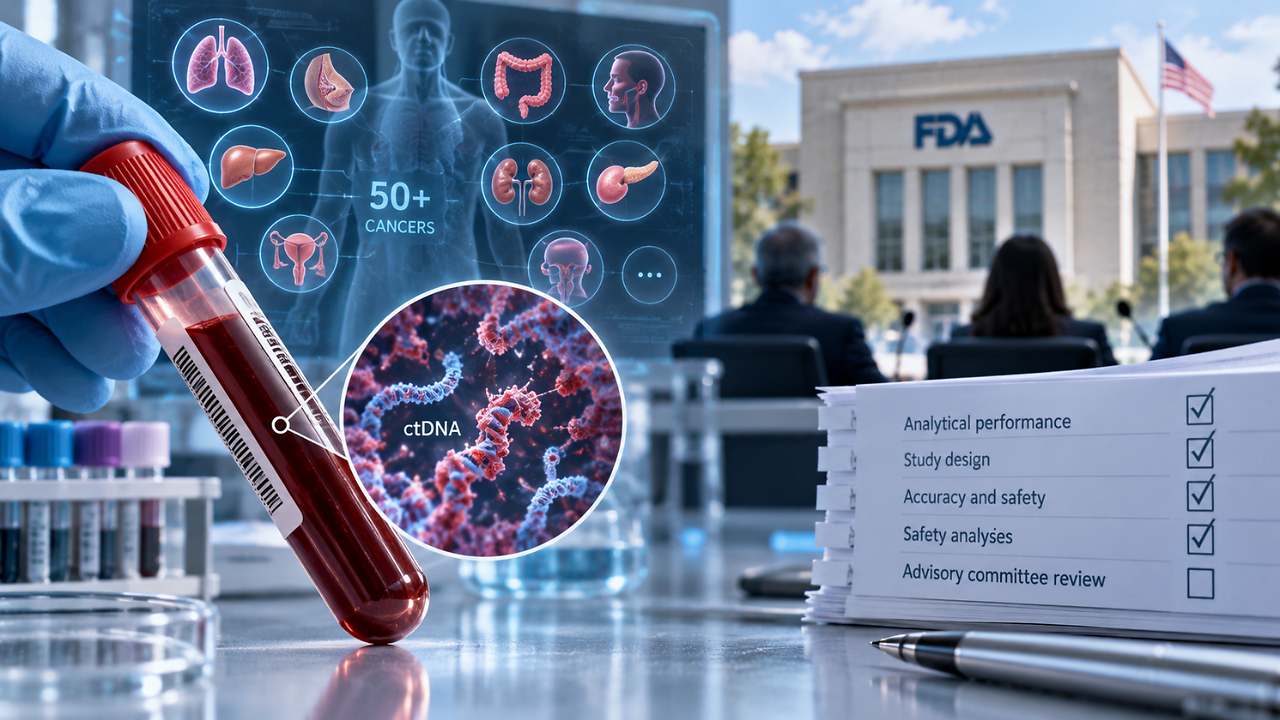
Biotechnology company Grail's vision of detecting more than 50 cancers with one blood test may soon become a reality after it showed promise of a positive outcome with the US Food and Drug Administration staff reviewers. According to Reuters, FDA has not raised any major concerns yet about the accuracy and of the blood test, Galleri, which is designed to capture signals from more than 50 types of cancer. The promising biomedical technology seems to be closer to a positive regulatory decision.FDA's Stance On Galleri Ahead of an advisory committee meeting on September 23, FDA briefing documents were released which said that reviewers had no outstanding questions regarding its accuracy, safety, overall analytical performance, and study design.However, this does not mean the FDA has approved Galleri. External advisers will now examine whether the available evidence is sufficient to back it and approve the multi-cancer early detection test.More About GalleriAlso read: From Remdesivir To Ventilators: COVID Patients Died Due To Hospital Protocols, Claims Whistleblower NurseGalleri is a type of multi-cancer early detection (MCED) test. Instead of searching for one specific cancer, it examines and analyses DNA fragments circulating in the blood for chemical patterns linked with various cancers.If the test detects a cancer signal, it also attempts to predict where in the body that signal originated, helping doctors decide which diagnostic tests may be needed next.The test is not meant to replace to existing cancer screening tests such as mammograms, colon cancer screening and cervical cancer screening. It is supposed to be used with existing screening methods for faster and more accurate diagnoses. One Question Still RemainsAlso read: LSD-Based Treatment Clears Second Phase 3 Trial: Could It Be The First New GAD Drug In 2 Decades?No multi-cancer detection test is currently FDA-authorised in the US. Some are available as laboratory-developed tests, but they do not undergo the same premarket approval process.Grail submitted Galleri for FDA premarket approval in January 2026. The application includes data from PATHFINDER 2, a US study involving more than 25,000 participants, as well as data from the large NHS-Galleri trial in the UK.The FDA's latest briefing documents describe the test as having a favourable benefit-risk profile, but advisers have been asked to consider an important question before making their decision. The question is does detecting a cancer signal translate into meaningful clinical benefit for patients? It's important as finding more cancers is not automatically the same as saving more lives.Galleri Has Also Faced Questions About Early Detection In February, Grail reported that its large UK NHS-Galleri trial did not significantly reduce the combined rate of stage III and IV cancers, the study's primary endpoint, across three screening rounds.Later analyses reported by Grail found reductions in stage IV diagnoses during screening rounds that were held later, but the company also acknowledged that the trial did not show a statistically significant reduction in the combined primary endpoint of stage III and IV cancers.This is why the FDA's question about whether Galleri should be considered an “early detection” test is particularly crucial.The FDA's Molecular and Clinical Genetics Panel of the Medical Devices Advisory Committee is scheduled to review the application on September 23. The panel's recommendation will help inform the FDA. If authorised, Galleri could become the first FDA-authorised multi-cancer detection test in the US.